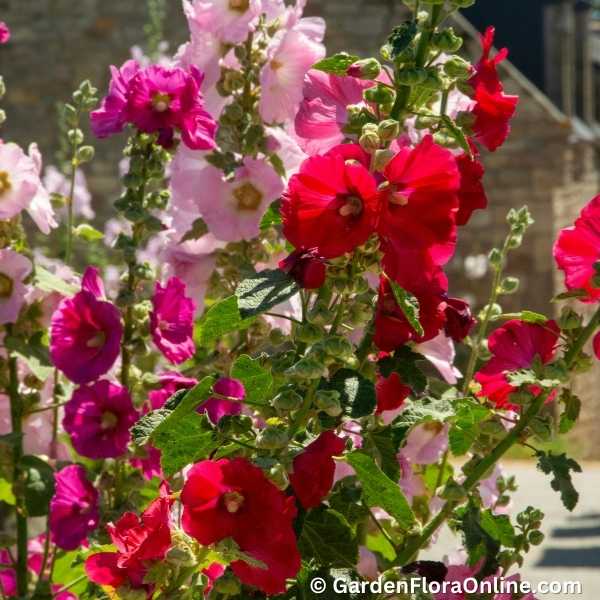
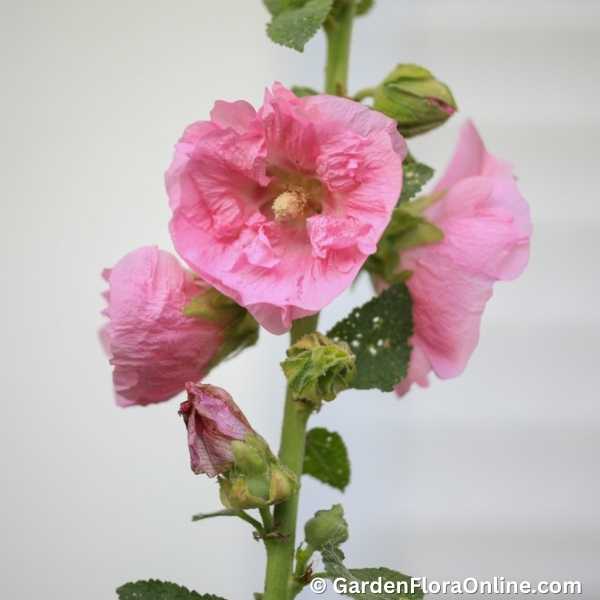
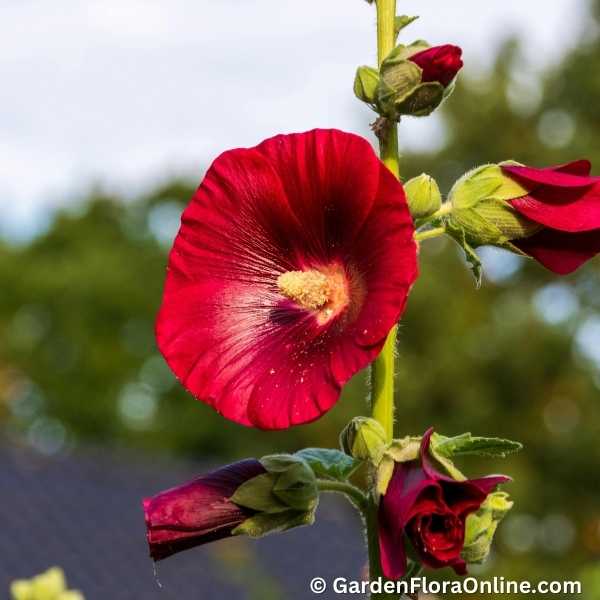
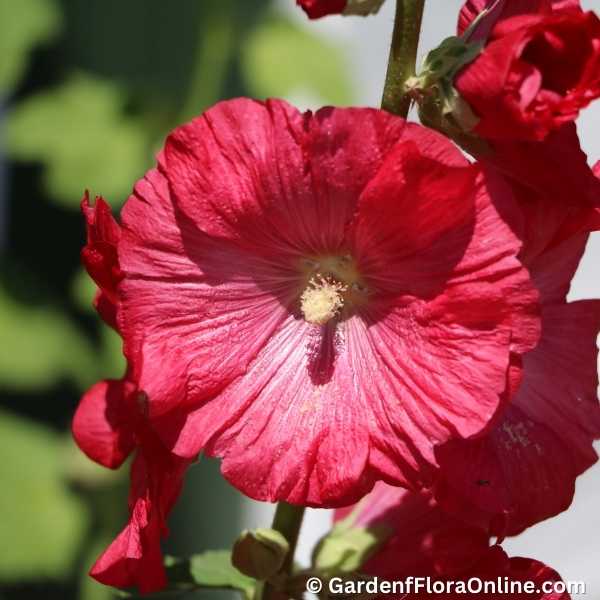
Alcea rosea is a tall, erect, biennial or short-lived perennial herb with stout, unbranched stems that can reach 1.5–2.5 m in height. Leaves are large, orbicular to reniform, palmately lobed, and covered with soft hairs, giving them a rough texture. Flowers are borne in long, axillary racemes and are large (8–12 cm across), showy, and available in a wide range of colours including pink, red, yellow, white, purple, and nearly black. The corolla is funnel-shaped, and the plant produces discoid schizocarpic fruits containing numerous rounded seeds.
Cultivation: Hollyhock grows best in sunny locations with well-drained, moderately fertile soil. Seeds are typically sown directly or started in nursery beds and transplanted when seedlings are small. The plant requires regular watering but should not be waterlogged. Staking may be needed in windy areas due to tall growth. Removing spent flowers promotes extended blooming, and mulching helps retain soil moisture. Alcea rosea is generally hardy and easy to grow, making it a popular choice for ornamental landscapes.